british petroleum [bp]
british petroleum [bp]
Introduction
Introduction
Deliver a polished, functional prototype of a Wind Farm Safety app-one that brings 2–3 critical user journeys to life.
Show operational value, real safety impact, and obvious scalability.
Create lightweight but confident early brand foundations support credibility without slowing momentum.
Secure £8m in funding.
Deliver a polished, functional prototype of a Wind Farm Safety app-one that brings 2–3 critical user journeys to life.
Show operational value, real safety impact, and obvious scalability.
Create lightweight but confident early brand foundations support credibility without slowing momentum.
Secure £8m in funding.
Year
Year
2020
2020
Industry
Industry
Oil and Gas
Oil and Gas
Scope of work
Scope of work
/
App Design
App Design
Timeline
Timeline
12 weeks
12 weeks
The quest
The quest
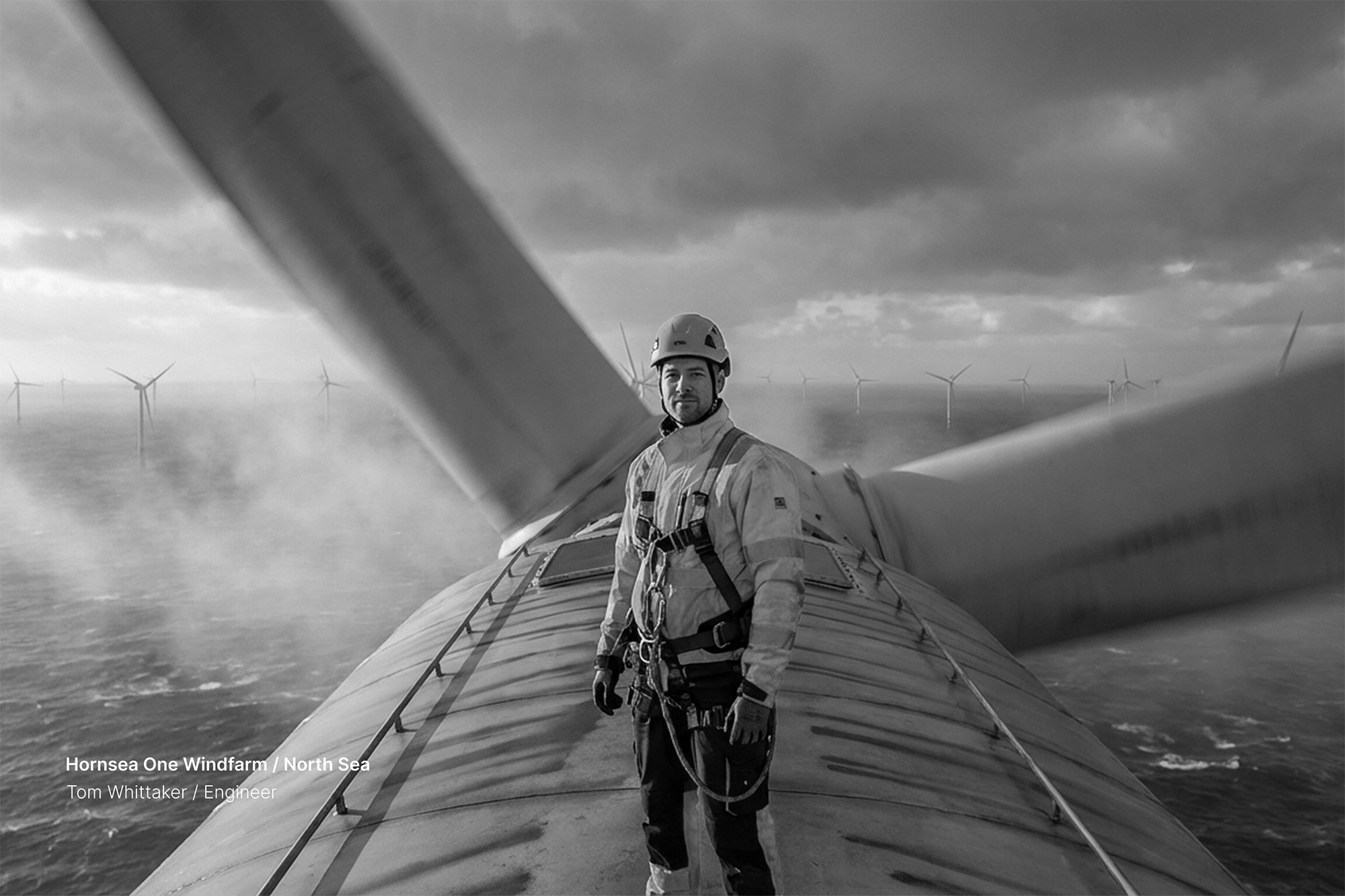
Wind Farm Engineers work in some of the most dangerous industrial environments in the world.
Remote locations. Extreme weather. Heavy machinery at height. One mistake can be fatal.
The challenge was to address their specific needs, motivations, and daily frustrations, without adding friction in moments where seconds matter.
My core responsibility focused on real-time, safety-driven communication.
Systems that ensure information moves fast, stays accurate, and reaches the right people immediately after an incident occurs.
First stop: direct conversations with BP’s wind farm engineers on the ground in Texas.
Wind Farm Engineers work in some of the most dangerous industrial environments in the world.
Remote locations. Extreme weather. Heavy machinery at height. One mistake can be fatal.
The challenge was to address their specific needs, motivations, and daily frustrations, without adding friction in moments where seconds matter.
My core responsibility focused on real-time, safety-driven communication.
Systems that ensure information moves fast, stays accurate, and reaches the right people immediately after an incident occurs.
First stop: direct conversations with BP’s wind farm engineers on the ground in Texas.
Wind Farm Engineers work in some of the most dangerous industrial environments in the world.
Remote locations. Extreme weather. Heavy machinery at height. One mistake can be fatal.
The challenge was to address their specific needs, motivations, and daily frustrations, without adding friction in moments where seconds matter.
My core responsibility focused on real-time, safety-driven communication.
Systems that ensure information moves fast, stays accurate, and reaches the right people immediately after an incident occurs.
First stop: direct conversations with BP’s wind farm engineers on the ground in Texas.
Empathy Workshops
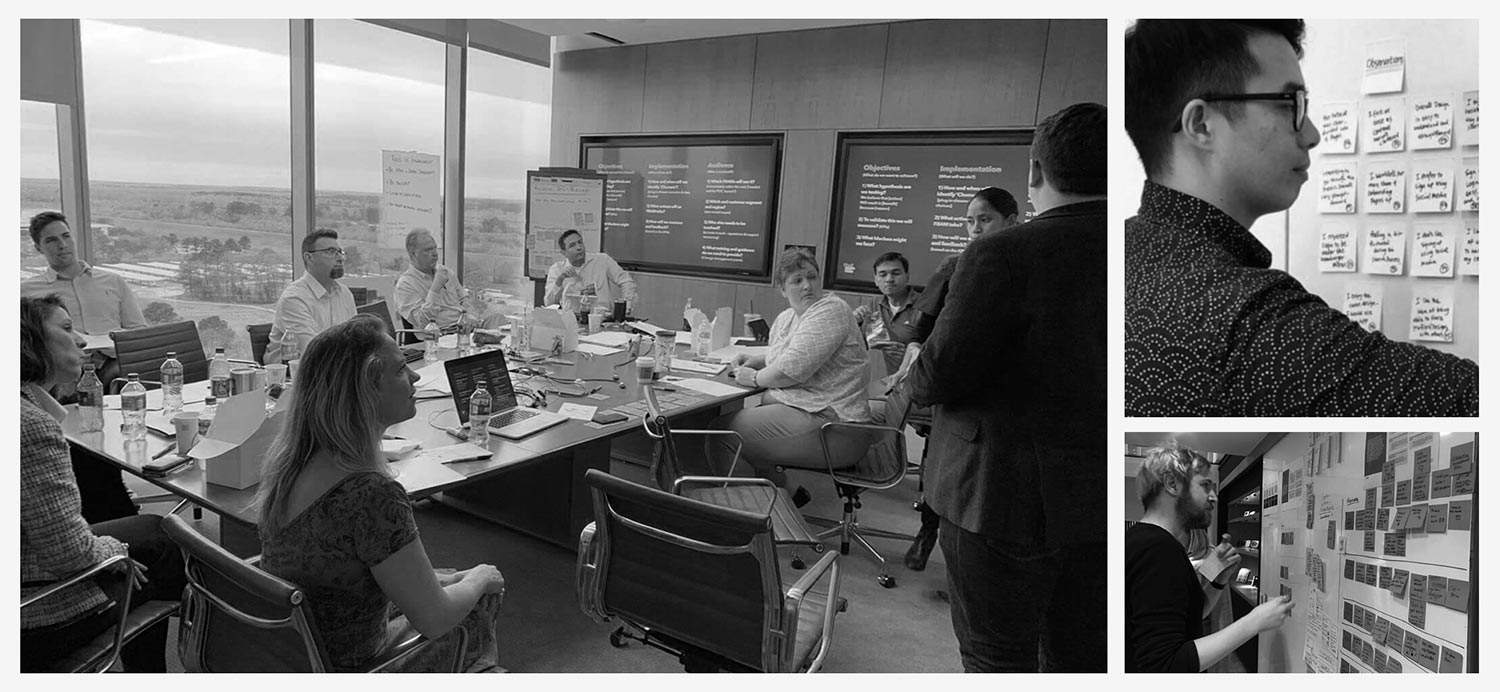
We worked through real operational scenarios with engineers, to unpack incidents, near-misses, and everyday workflows. These inputs were then sorted, clustered, and debated as a group, allowing recurring themes and pressure points to emerge across different situations.
From this, evaluated the moments carrying the greatest risk or impact, revealing:
Critical incidents are often slowed by delays and miscommunication.
High-risk environments create sustained levels of stress that affect
decision-making.Existing real-time safety protocols are perceived as time-consuming in urgent situations.
Engineers want greater autonomy when responding to incidents in the field.
Gaps in historical and live incident information make it harder to act with confidence.
We worked through real operational scenarios with engineers, to unpack incidents, near-misses, and everyday workflows. These inputs were then sorted, clustered, and debated as a group, allowing recurring themes and pressure points to emerge across different situations.
From this, evaluated the moments carrying the greatest risk or impact, revealing:
Critical incidents are often slowed by delays and miscommunication.
High-risk environments create sustained levels of stress that affect
decision-making.Existing real-time safety protocols are perceived as time-consuming in urgent situations.
Engineers want greater autonomy when responding to incidents in the field.
Gaps in historical and live incident information make it harder to act with confidence.
We worked through real operational scenarios with engineers, to unpack incidents, near-misses, and everyday workflows. These inputs were then sorted, clustered, and debated as a group, allowing recurring themes and pressure points to emerge across different situations.
From this, evaluated the moments carrying the greatest risk or impact, revealing:
Critical incidents are often slowed by delays and miscommunication.
High-risk environments create sustained levels of stress that affect
decision-making.Existing real-time safety protocols are perceived as time-consuming in urgent situations.
Engineers want greater autonomy when responding to incidents in the field.
Gaps in historical and live incident information make it harder to act with confidence.
Synthesis
We surfaced recurring patterns around communication breakdowns, decision-making under pressure-gaps in shared safety knowledge.
While multiple operational journeys surfaced, two consistently carried the highest risk and impact: how new incidents are logged in real time, and how outstanding learnings are reviewed and shared after the fact.
Given the 12-week timeframe, we deliberately focused on these journeys to address the moments where clarity, speed, and ownership most directly influence safety outcomes.
We surfaced recurring patterns around communication breakdowns, decision-making under pressure, and gaps in shared safety knowledge.
While multiple operational journeys surfaced, two consistently carried the highest risk and impact: how new incidents are logged in real time, and how outstanding tasks and learnings are reviewed and shared after the fact.
Given the 12-week timeframe, we deliberately focused on these journeys to address the moments where clarity, speed, and ownership most directly influence safety outcomes.
We surfaced recurring patterns around communication breakdowns, decision-making under pressure, and gaps in shared safety knowledge.
While multiple operational journeys surfaced, two consistently carried the highest risk and impact: how new incidents are logged in real time, and how outstanding tasks and learnings are reviewed and shared after the fact.
Given the 12-week timeframe, we deliberately focused on these journeys to address the moments where clarity, speed, and ownership most directly influence safety outcomes.
Personas
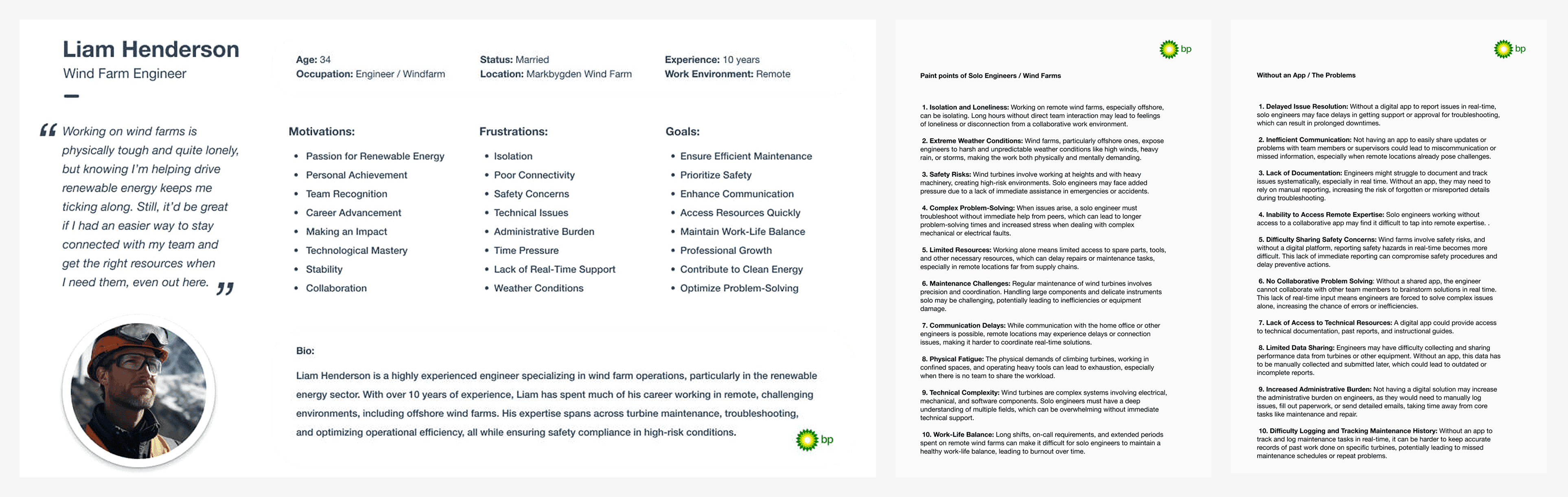
The persona captures what it’s really like to work as a wind farm engineer — remote, often alone or small 2 person teams, under pressure, and responsible for making the right call in high-risk situations.
Keeping these realities front of mind helped us design with empathy, focusing on clear communication, quick access to information, and support when it matters most.
The persona captures what it’s really like to work as a wind farm engineer — remote, often alone, under pressure, and responsible for making the right call in high-risk situations.
Keeping these realities front of mind helped us design with empathy, focusing on clear communication, quick access to information, and support when it matters most.
The persona captures what it’s really like to work as a wind farm engineer — remote, often alone, under pressure, and responsible for making the right call in high-risk situations.
Keeping these realities front of mind helped us design with empathy, focusing on clear communication, quick access to information, and support when it matters most.
Key User Flows
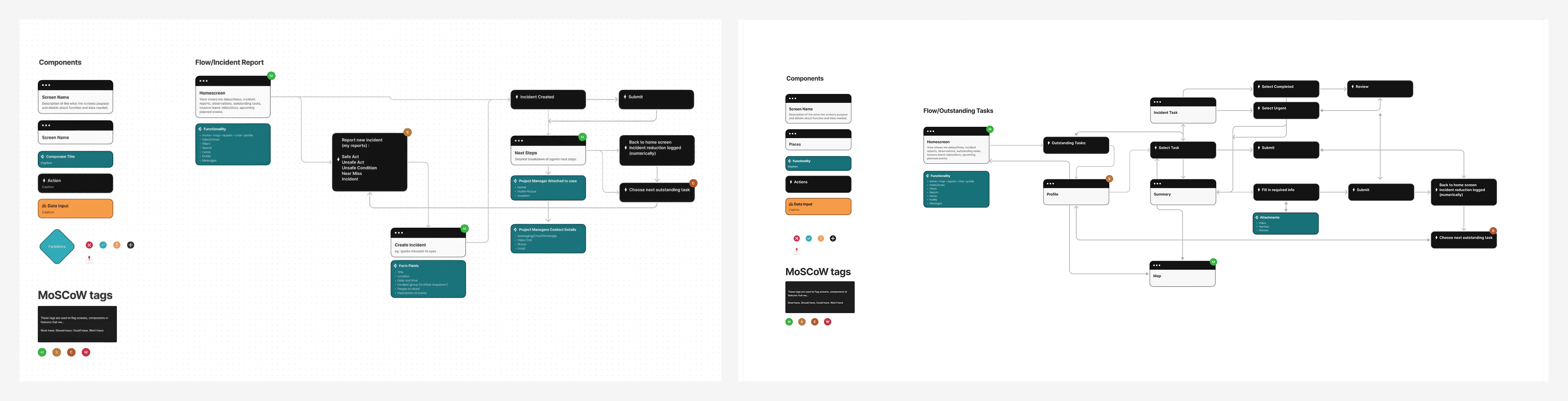
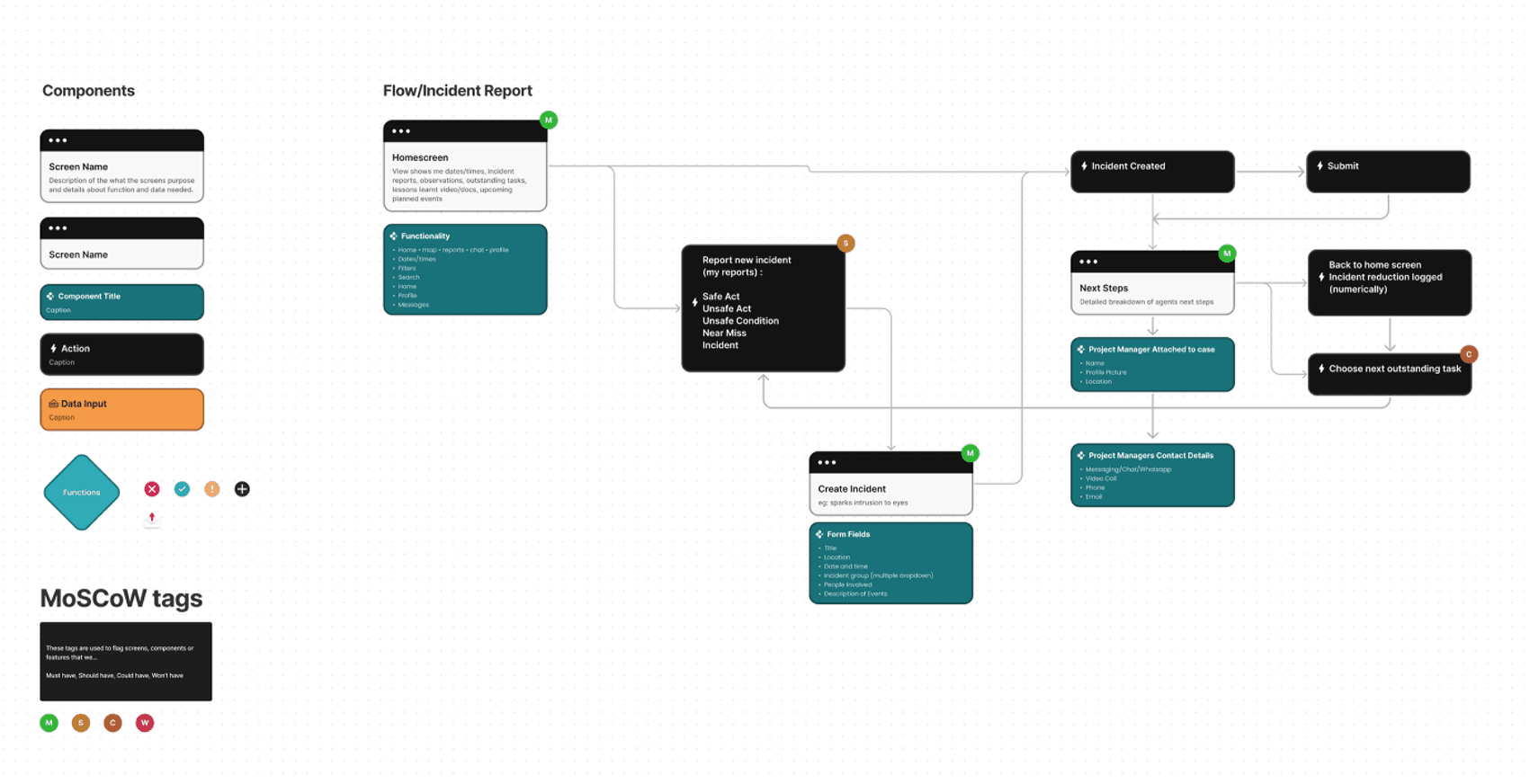
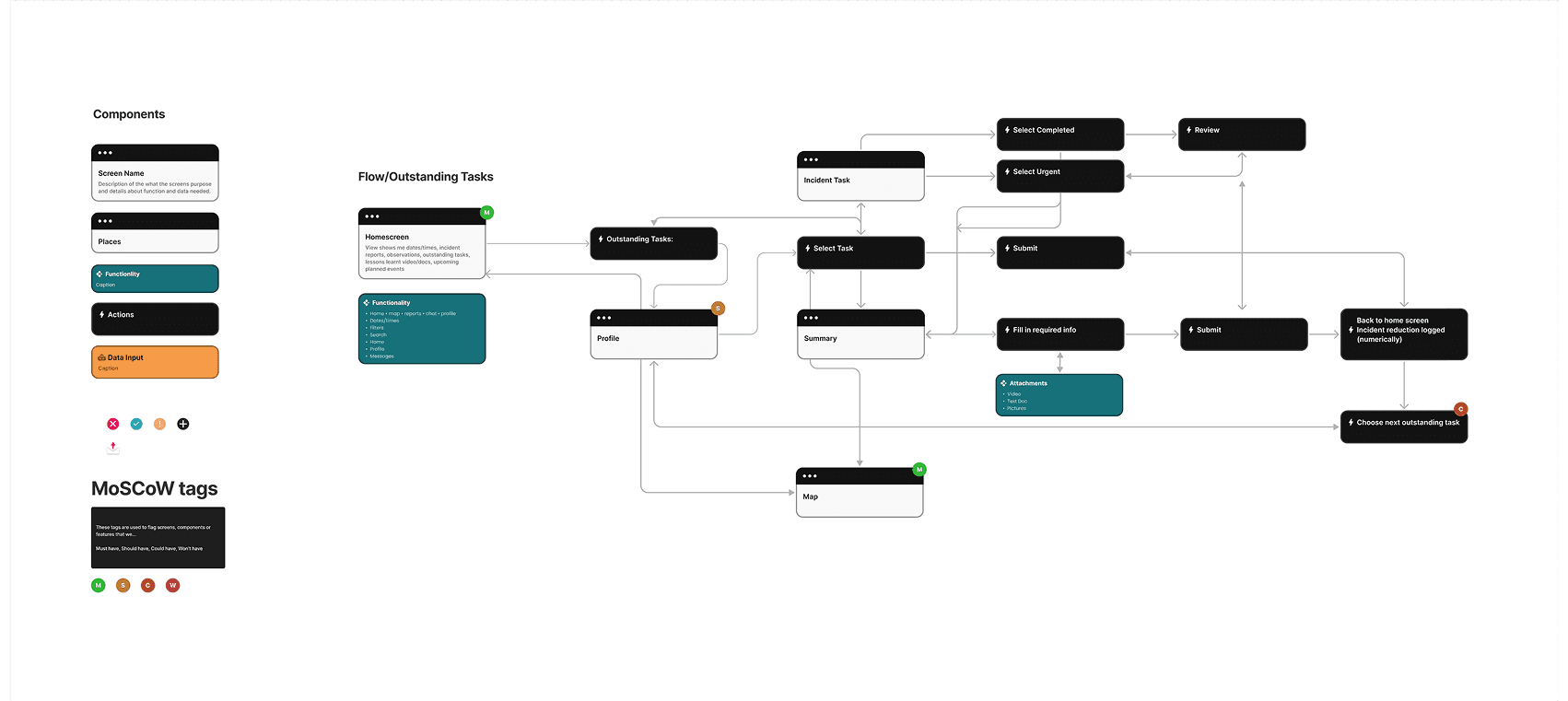
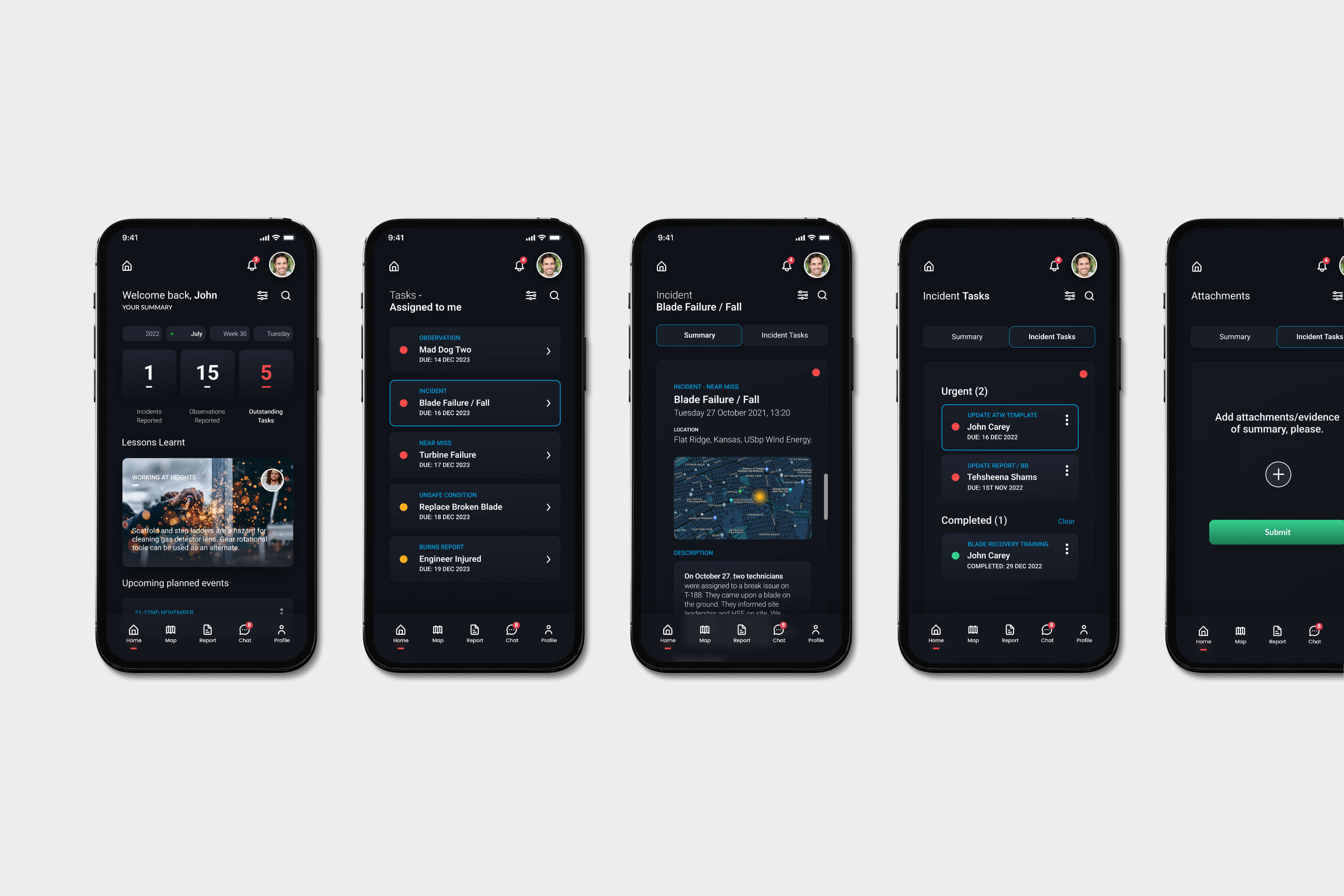
We chose two flows: Incident Report + Outstanding Tasks.
The Incident flow prioritises speed and clarity.
It helps engineers capture the right information in the moment.
Potentially life-saving information is shared instantly.
The Outstanding Tasks flow supports reflection and follow-up.
It makes it easy for managers to review learnings, complete actions, share knowledge back into the field in real time.
We chose two flows: Incident + Outstanding Tasks.
The 'Incident' flow prioritises speed and clarity, helping engineers capture the right information in that moment, allowing the sharing of potentially life saving information, instantly.
The 'Outstanding tasks' flow supports reflection and follow-up, making it easy for managers to review learnings, complete actions, and share knowledge back into the field.
We chose two flows: Incident Report + Outstanding Tasks.
The Incident flow prioritises speed and clarity.
It helps engineers capture the right information in the moment.
Potentially life-saving information is shared instantly.
The Outstanding Tasks flow supports reflection and follow-up. It makes it easy for managers to review learnings, complete actions, share knowledge back into the field in real time.
We chose two flows: Incident + Outstanding Tasks.
The 'Incident' flow prioritises speed and clarity, helping engineers capture the right information in that moment, allowing the sharing of potentially life saving information, instantly.
The 'Outstanding tasks' flow supports reflection and follow-up, making it easy for managers to review learnings, complete actions, and share knowledge back into the field.
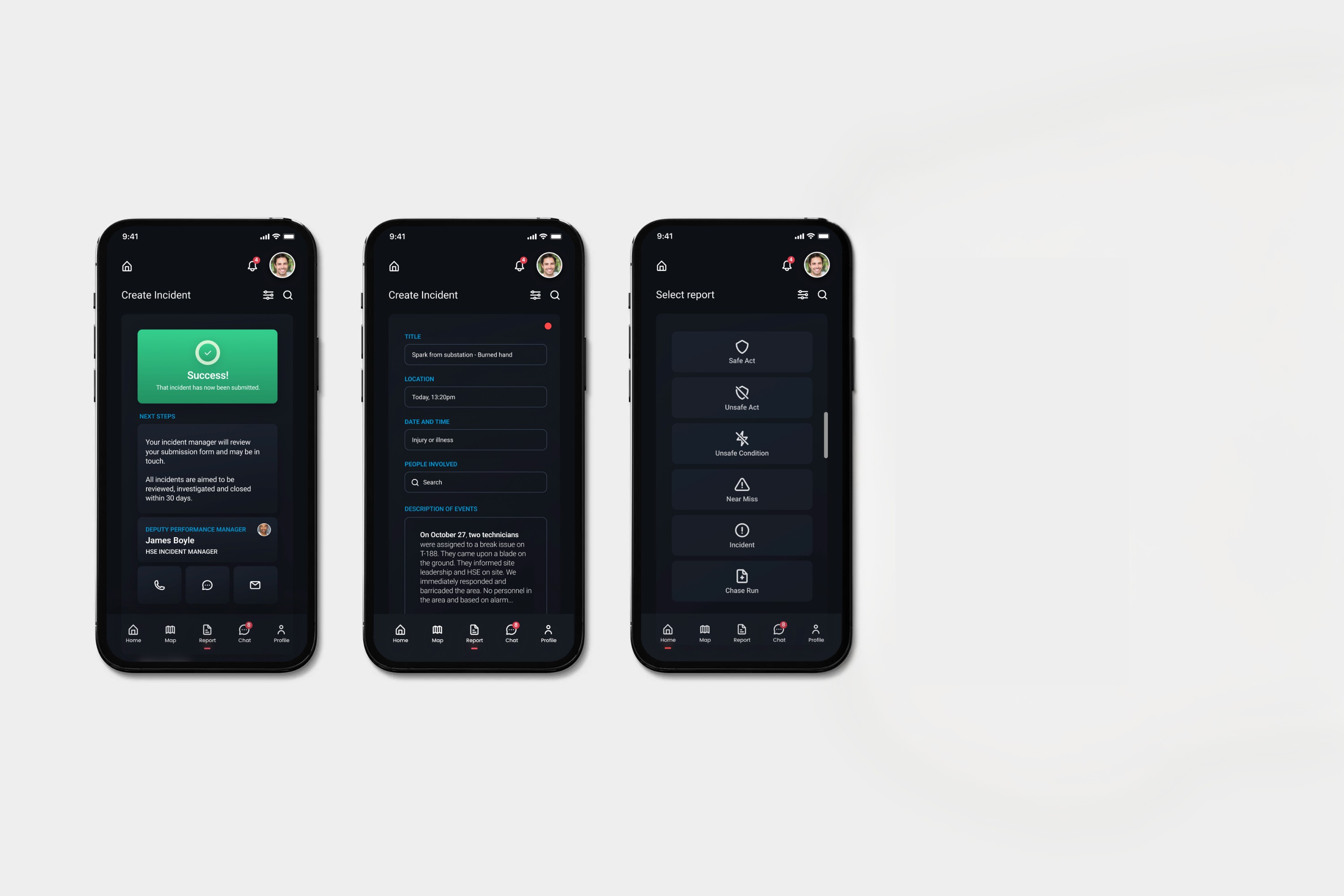
Wireframes / New Incident
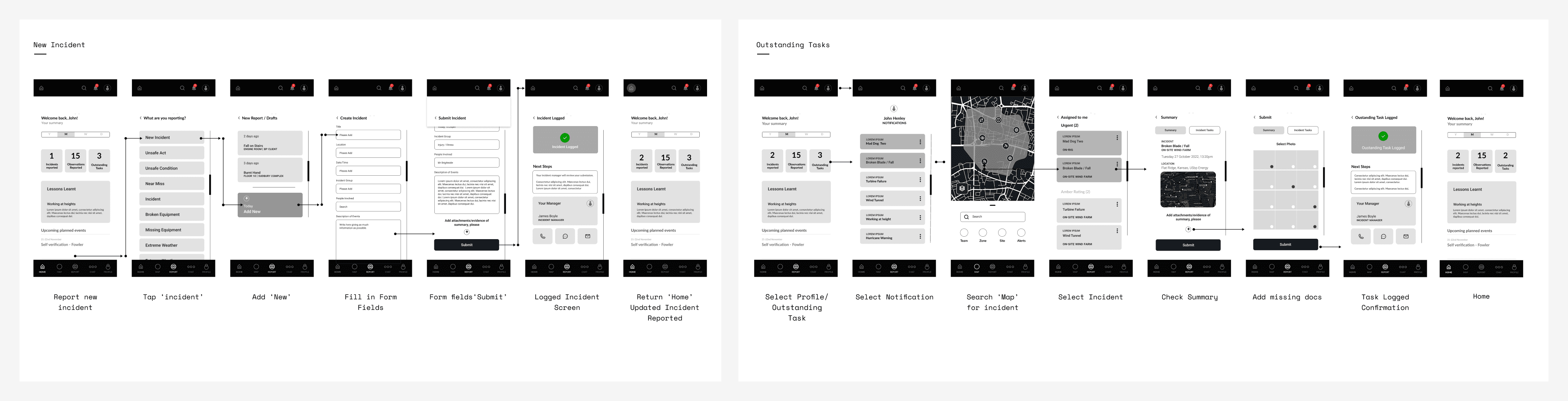
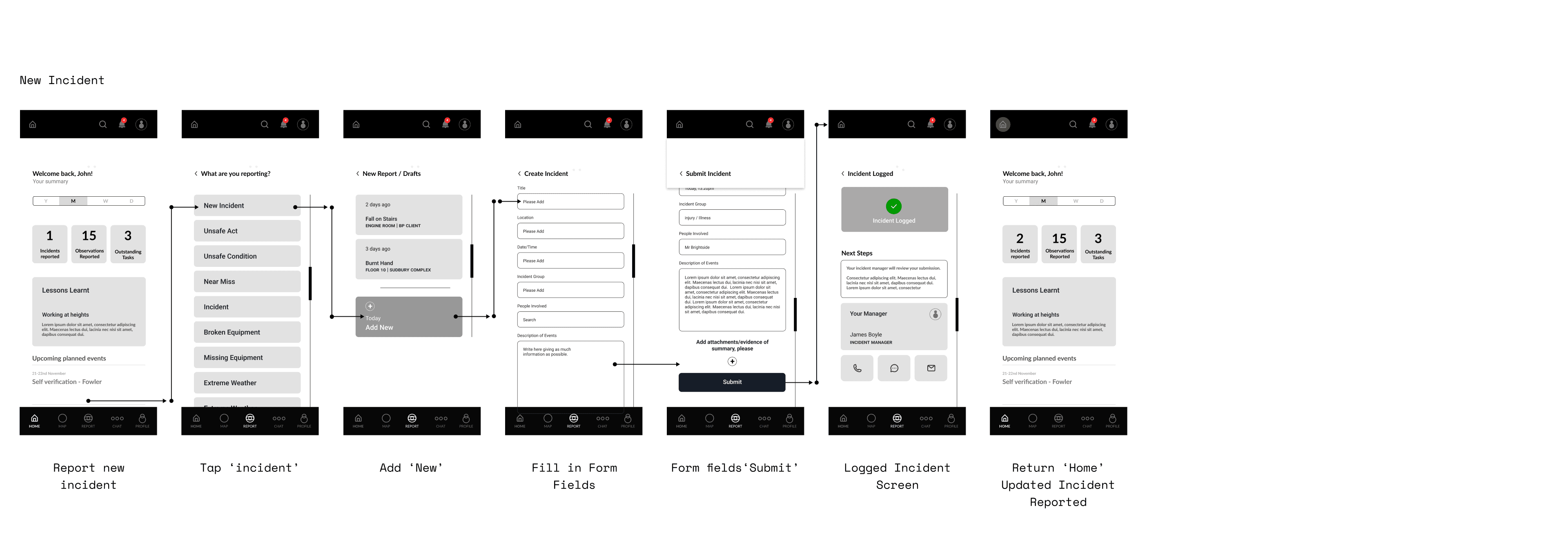
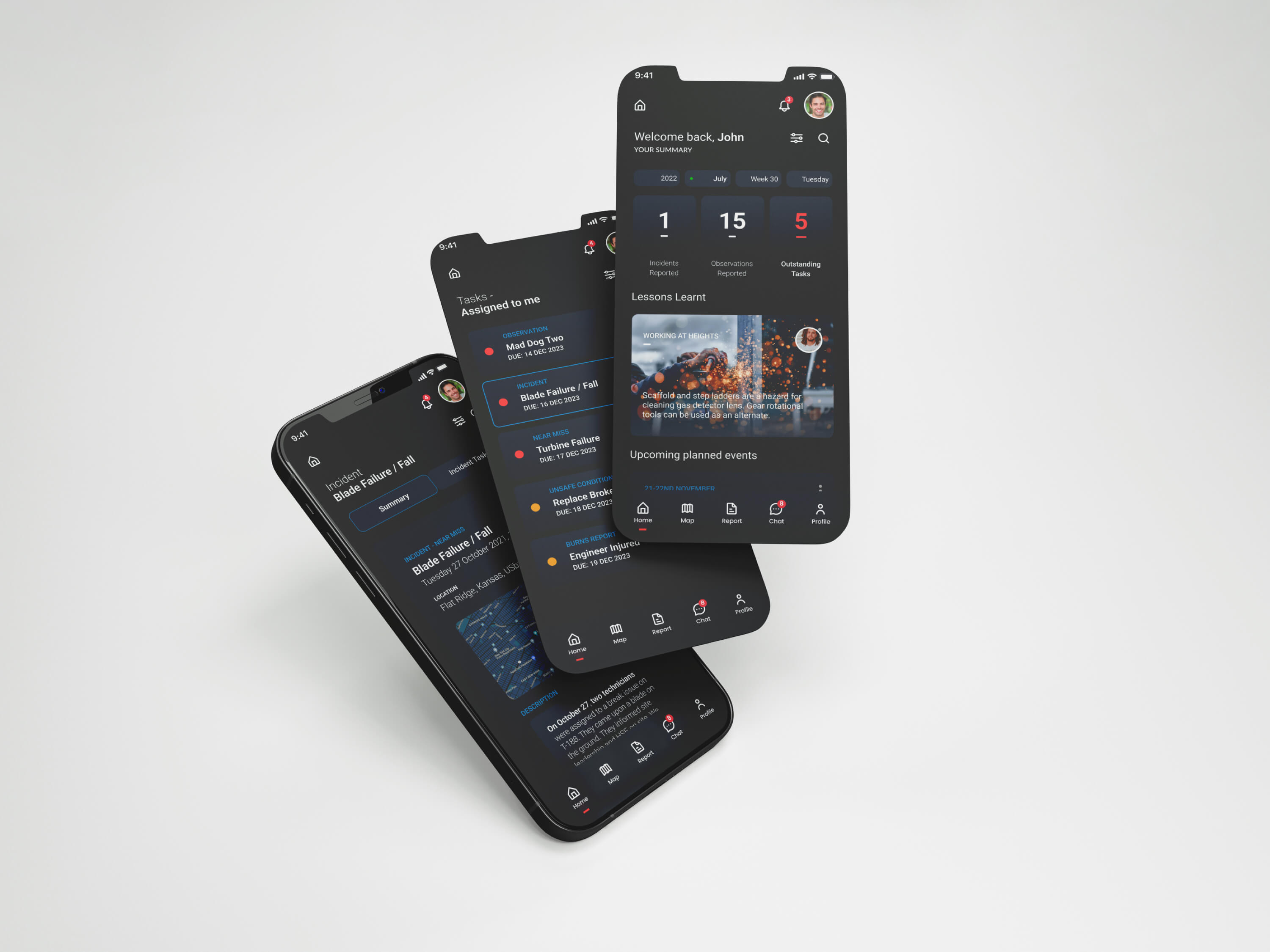
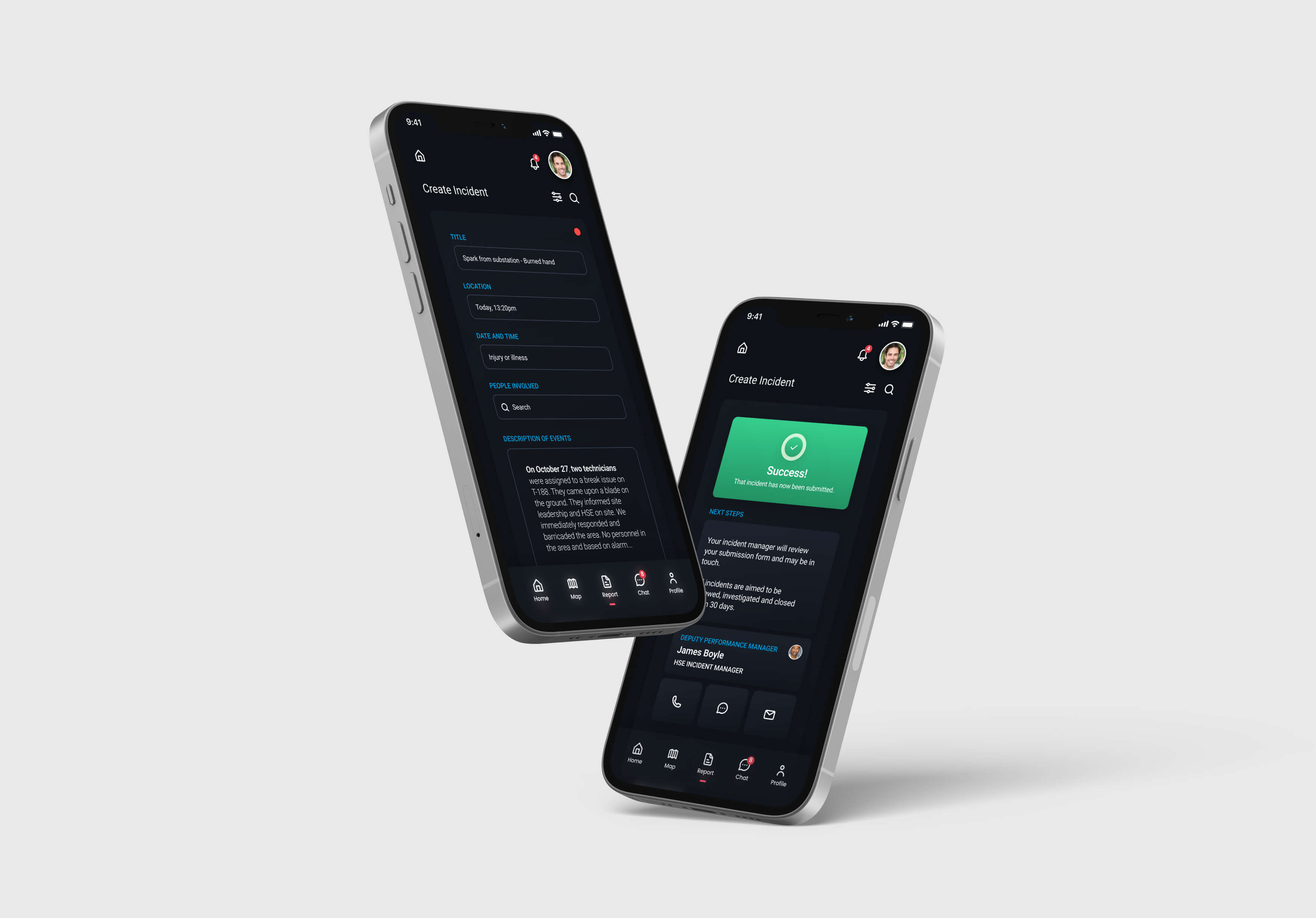
This journey helps engineers capture incidents quickly while they’re still on site. The flow minimises friction at incident, and immediately returns clear next steps.
By doing this, it replaces slow, rarely-used legacy systems with something engineers can actually rely on-real time knowledge.
This journey helps engineers capture incidents quickly while they’re still on site, often working alone and under pressure. The flow minimises friction, guides the right inputs at the right moment, and immediately returns clear next steps.
By doing this, it replaces slow, rarely-used legacy systems with something engineers can actually rely on when time and safety matter most.
This journey helps engineers capture incidents quickly while they’re still on site, often working alone and under pressure. The flow minimises friction, guides the right inputs at the right moment, and immediately returns clear next steps.
By doing this, it replaces slow, rarely-used legacy systems with something engineers can actually rely on when time and safety matter most.
Wireframes / Outstanding Tasks
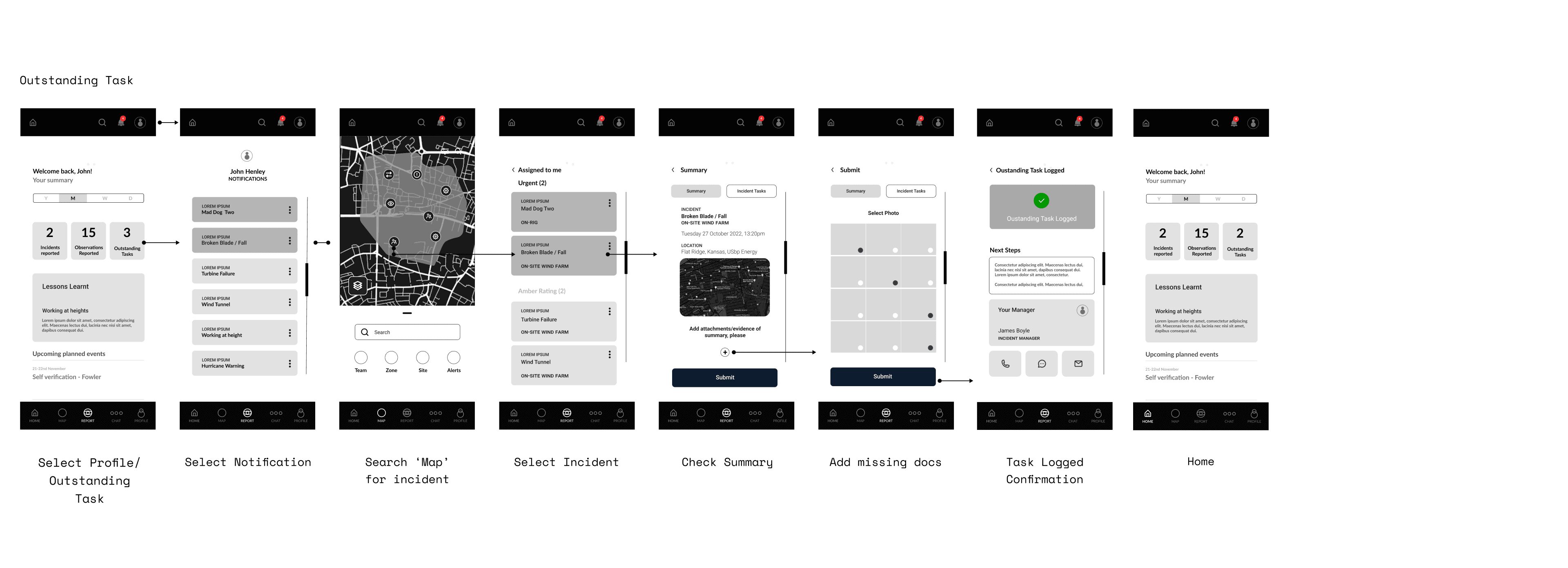
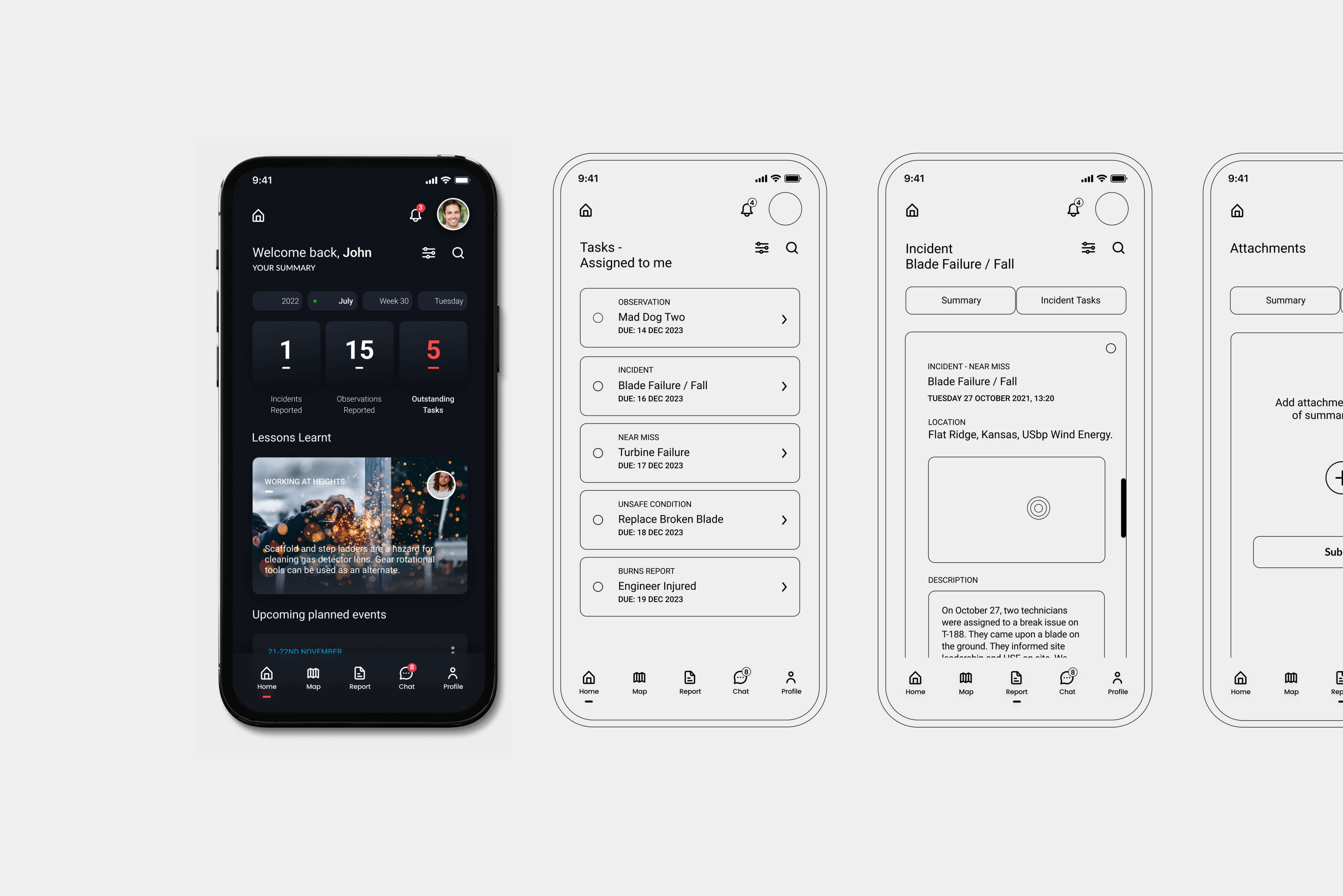
This journey supports engineers and site managers in closing the loop after an incident, making unfinished actions and missing information visible.
It allows teams to add context, upload evidence, and review learnings in one place. The result is a shared, living record. It strengthens accountability and feeds practical knowledge back to engineers in the field.
This journey supports engineers and site managers in closing the loop after an incident, making unfinished actions and missing information visible.
It allows teams to add context, upload evidence, and review learnings in one place. The result is a shared, living record. It strengthens accountability and feeds practical knowledge back to engineers in the field.
This journey supports engineers and site managers in closing the loop after an incident, making unfinished actions and missing information visible.
It allows teams to add context, upload evidence, and review learnings in one place. The result is a shared, living record. It strengthens accountability and feeds practical knowledge back to engineers in the field.
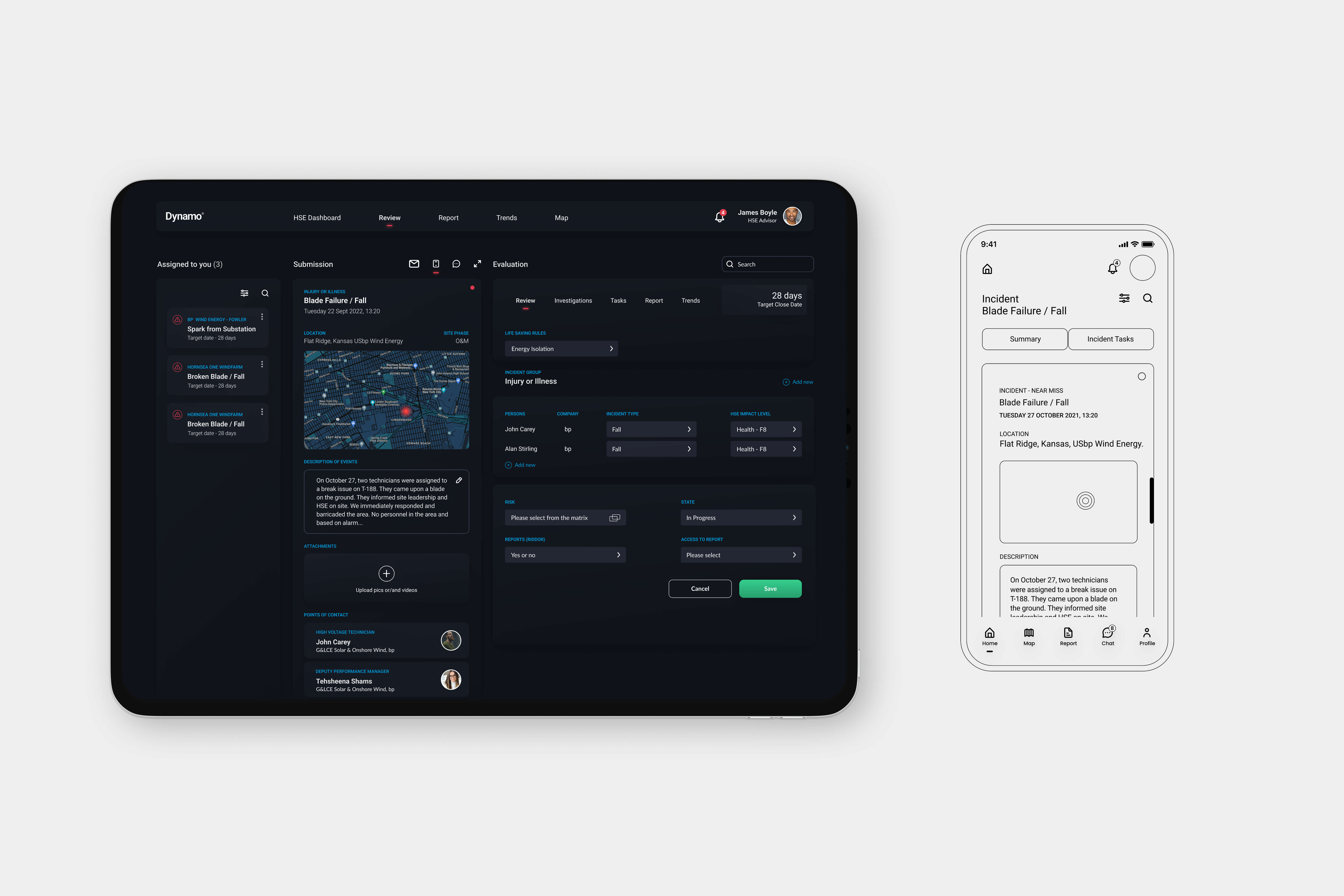

Wireframes / Extending to Desktop
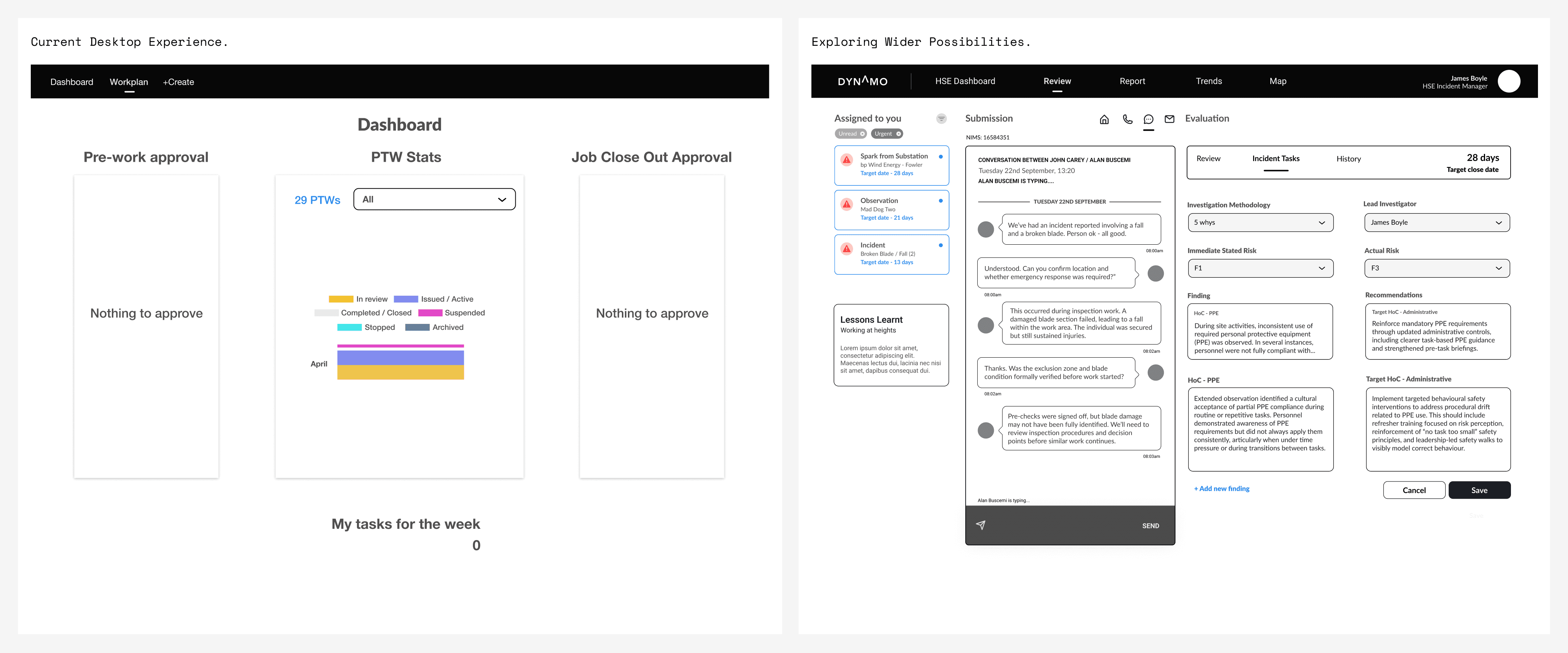
The original desktop experience focused heavily on form completion, with information spread across long, linear layouts and no thought to design outcomes.
Barely functioning, it made it difficult for managers to quickly assess risk, understand incident context, or track progress across investigations.
Minimal structure and prioritisation forced reviewers to constantly scan, switch between sections, and hold critical safety information in working memory - information that was effectively unretrievable for working engineers.
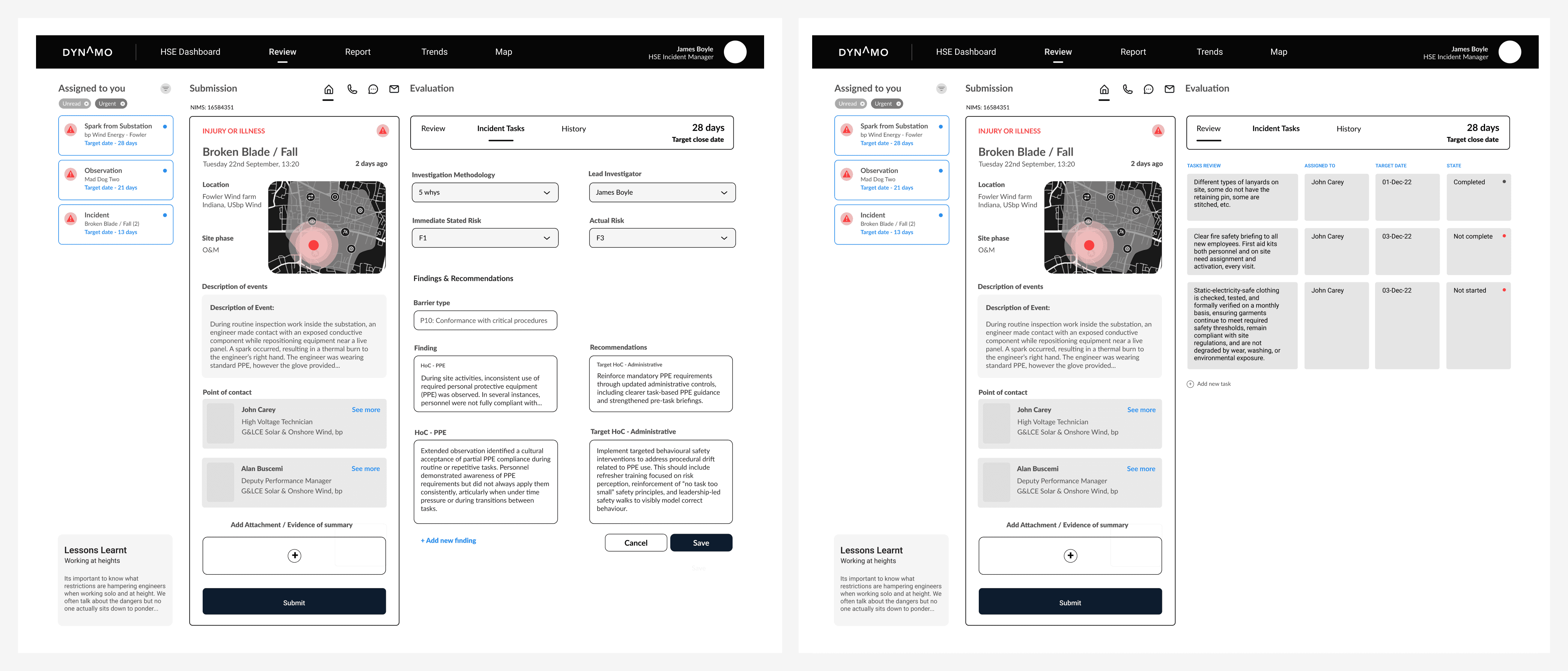
Although desktop creation was not a focussed deliverable, we added depth to our narrative by exploring some desktop scenarios.
The original desktop experience focused heavily on form completion, with information spread across long, linear layouts and no thought to design outcomes.
Barely functioning, it made it difficult for managers to quickly assess risk, understand incident context, or track progress across investigations.
Although desktop creation was not a focussed deliverable, we added depth to our narrative by exploring some desktop scenarios.
The original desktop experience focused heavily on form completion, with information spread across long, linear layouts and no thought to design outcomes.
Barely functioning, it made it difficult for managers to quickly assess risk, understand incident context, or track progress across investigations.
Minimal structure and prioritisation forced reviewers to constantly scan, switch between sections, and hold critical safety information in working memory - information that was effectively unretrievable for working engineers.
Although desktop creation was not a focussed deliverable, we added depth to our narrative by exploring some desktop scenarios.
Building a story
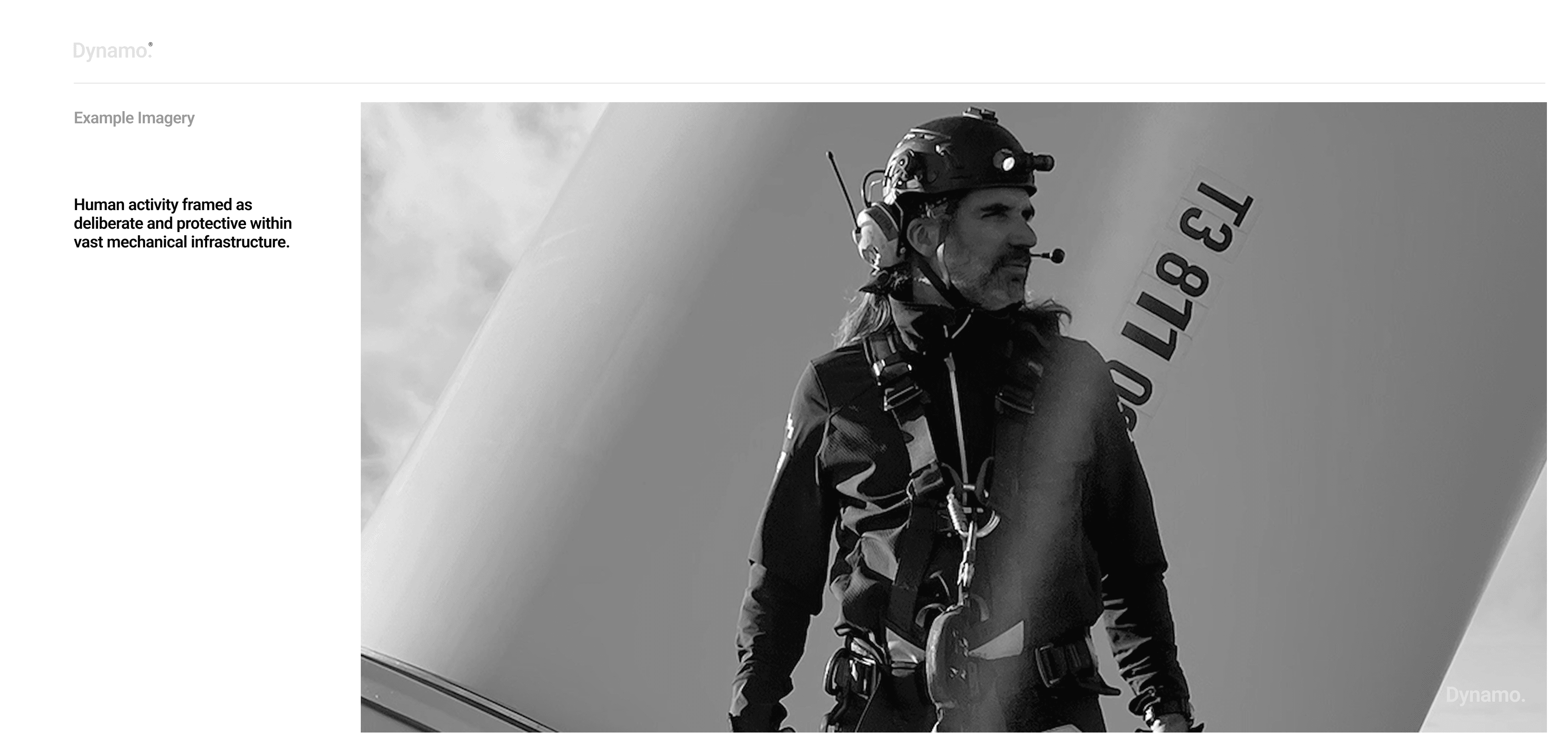
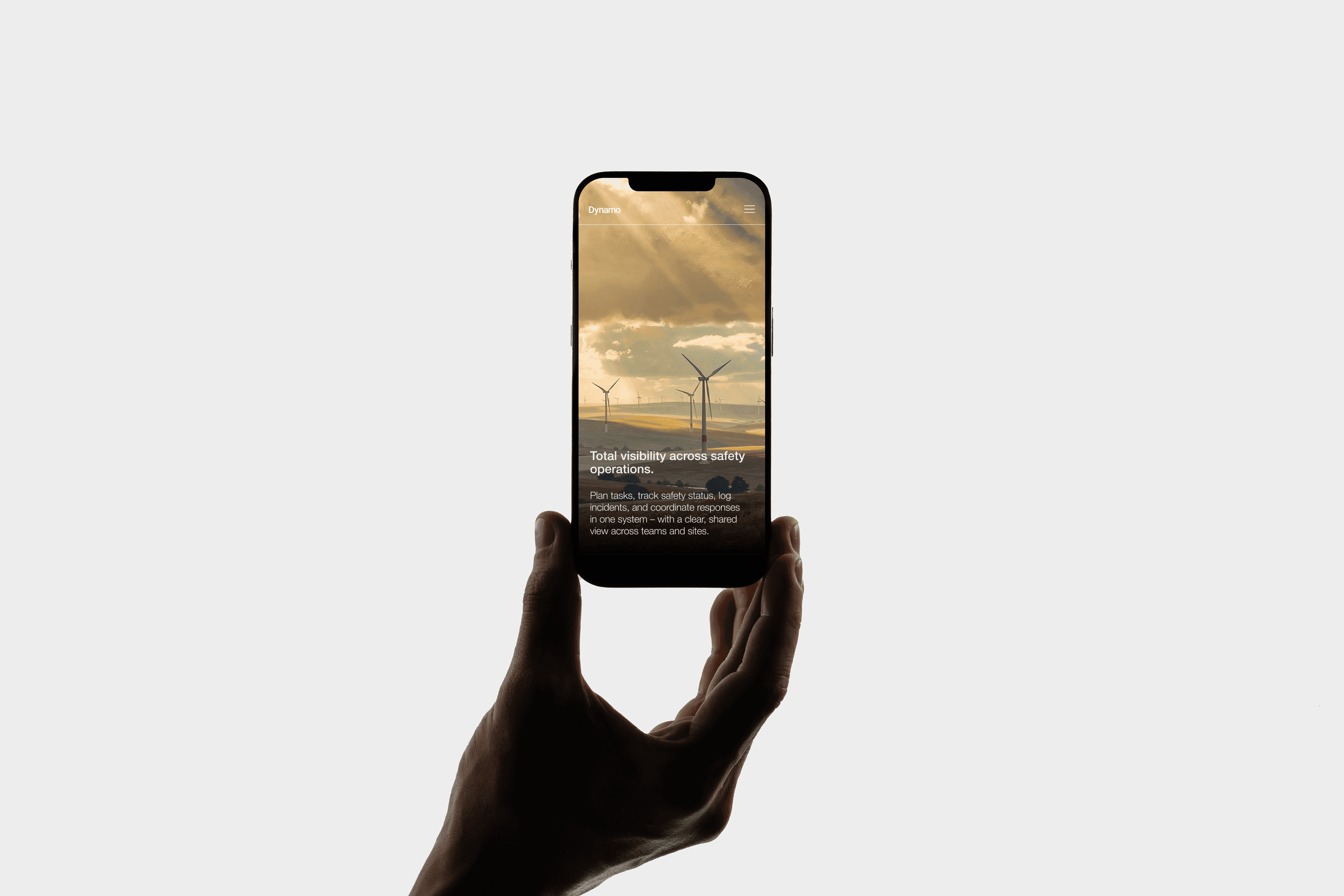
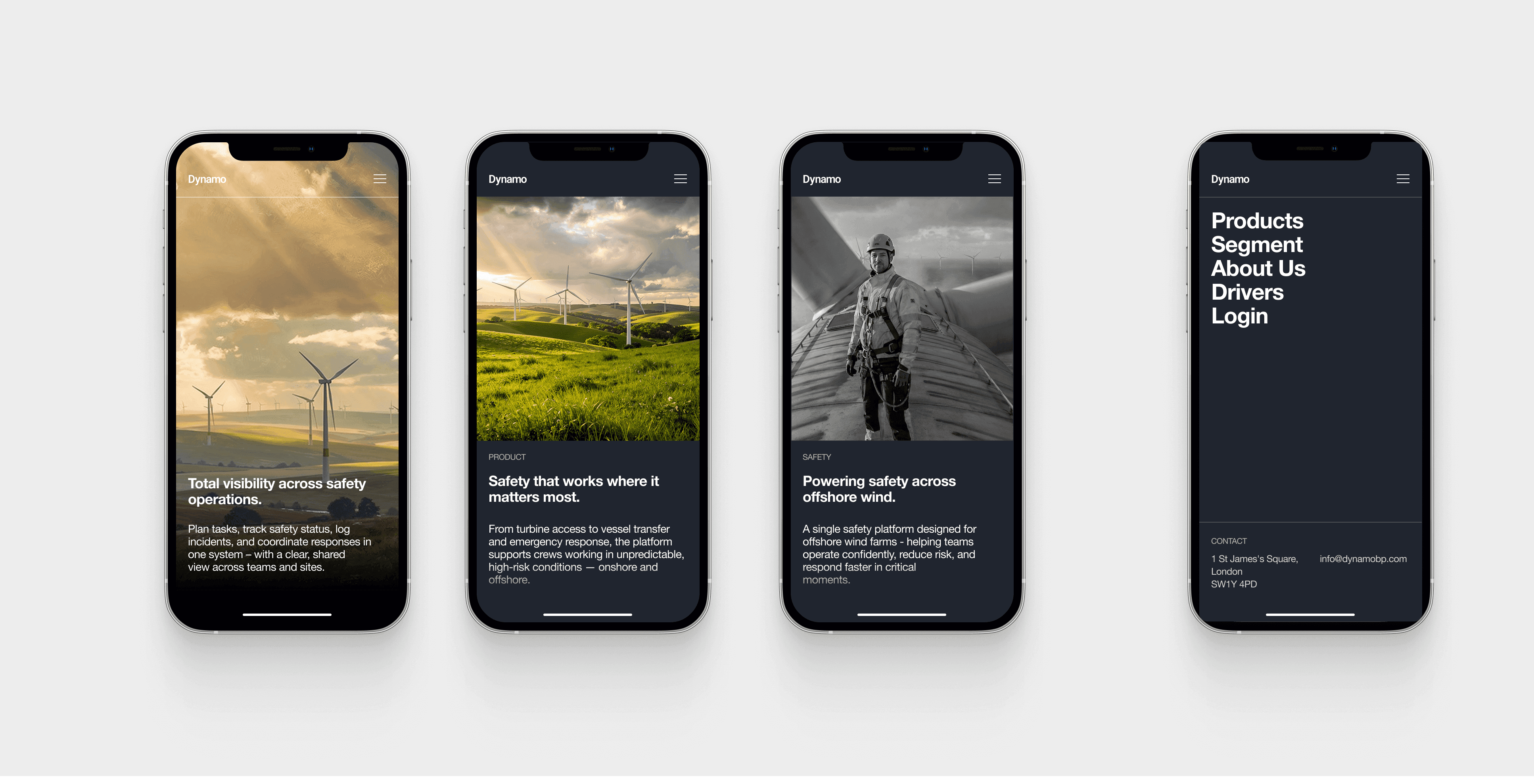
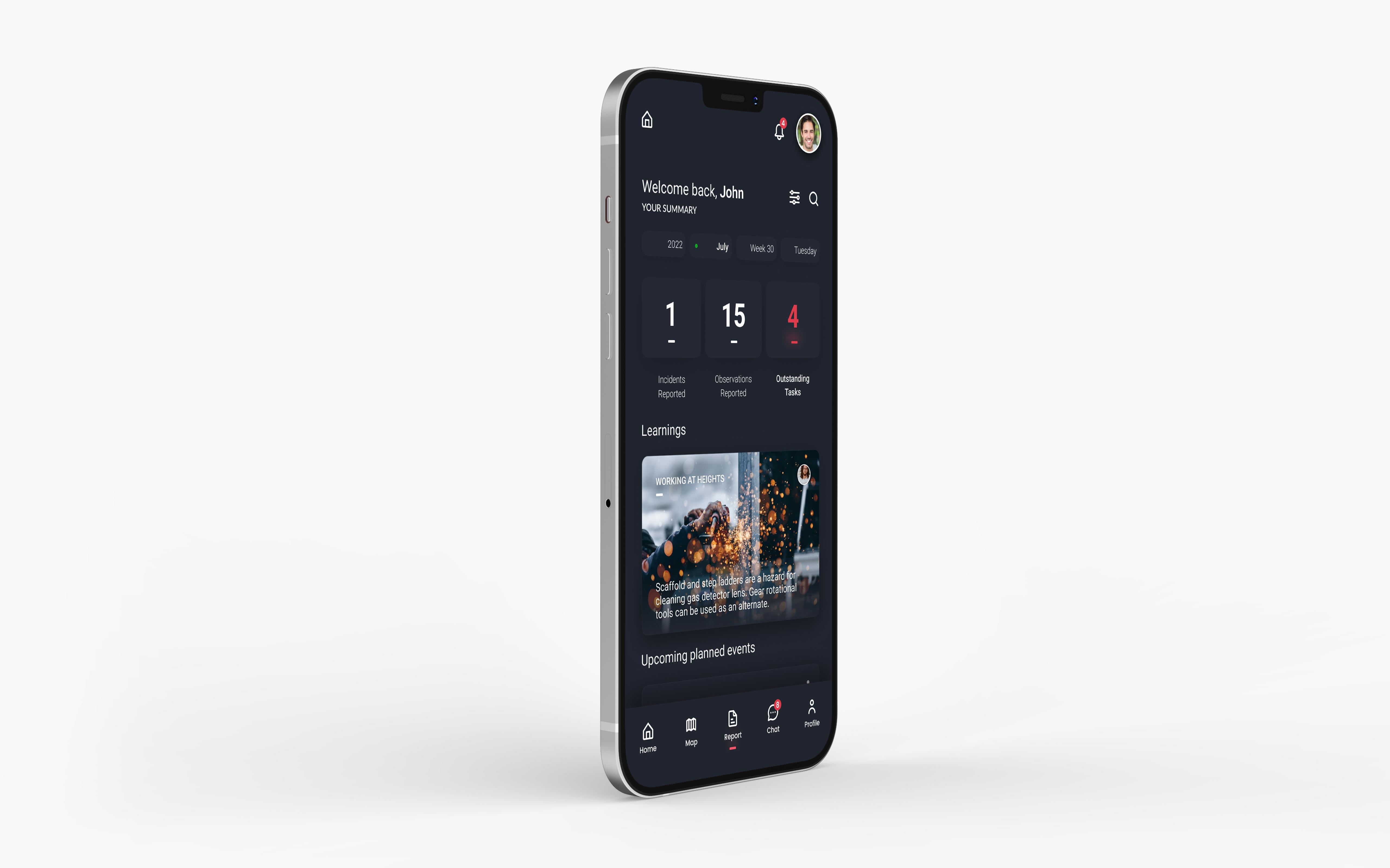
To help sell the pitch and secure £8m in funding, I needed to establish a clear, credible brand story—one that made the product feel cohesive, trustworthy, and easy to understand through visual storytelling.
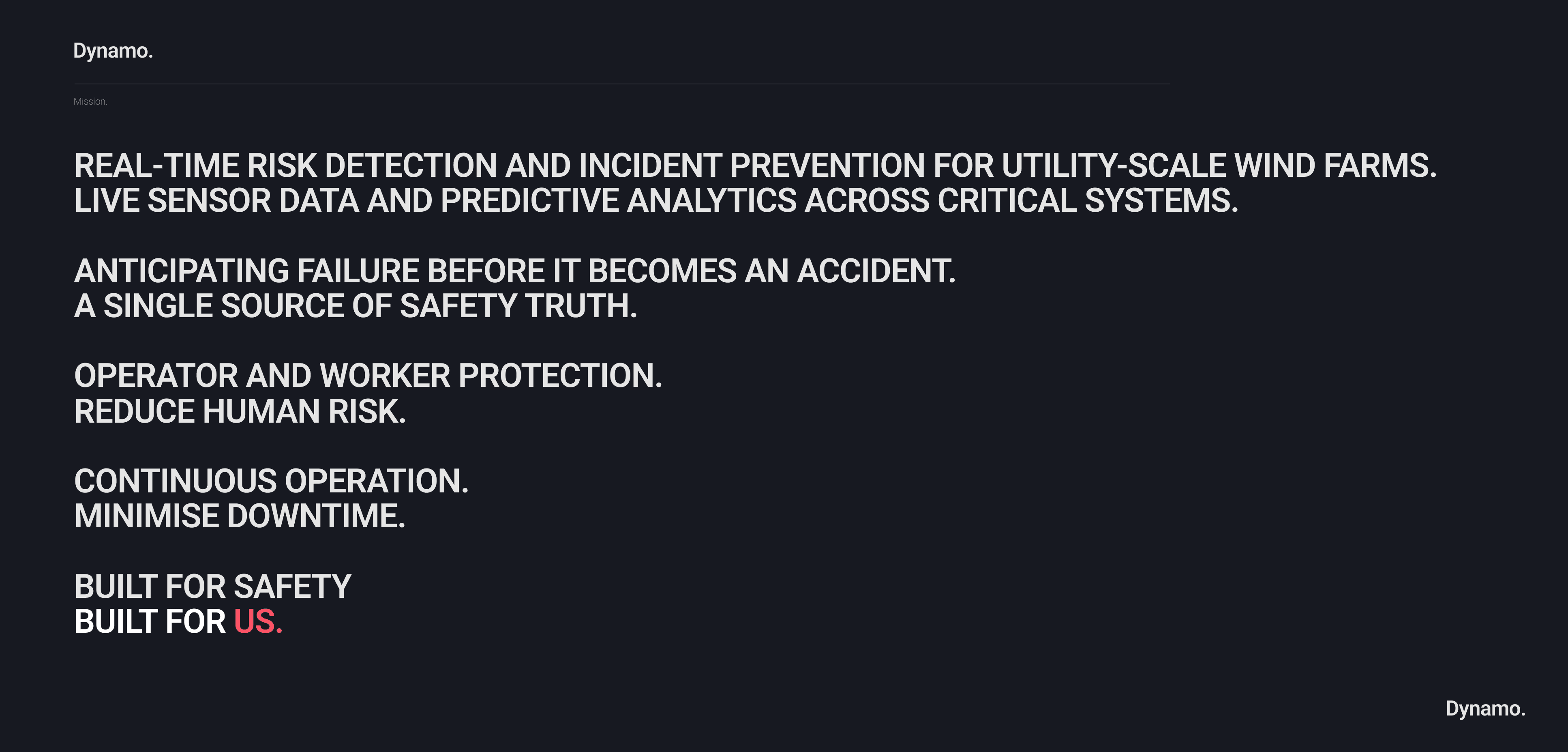
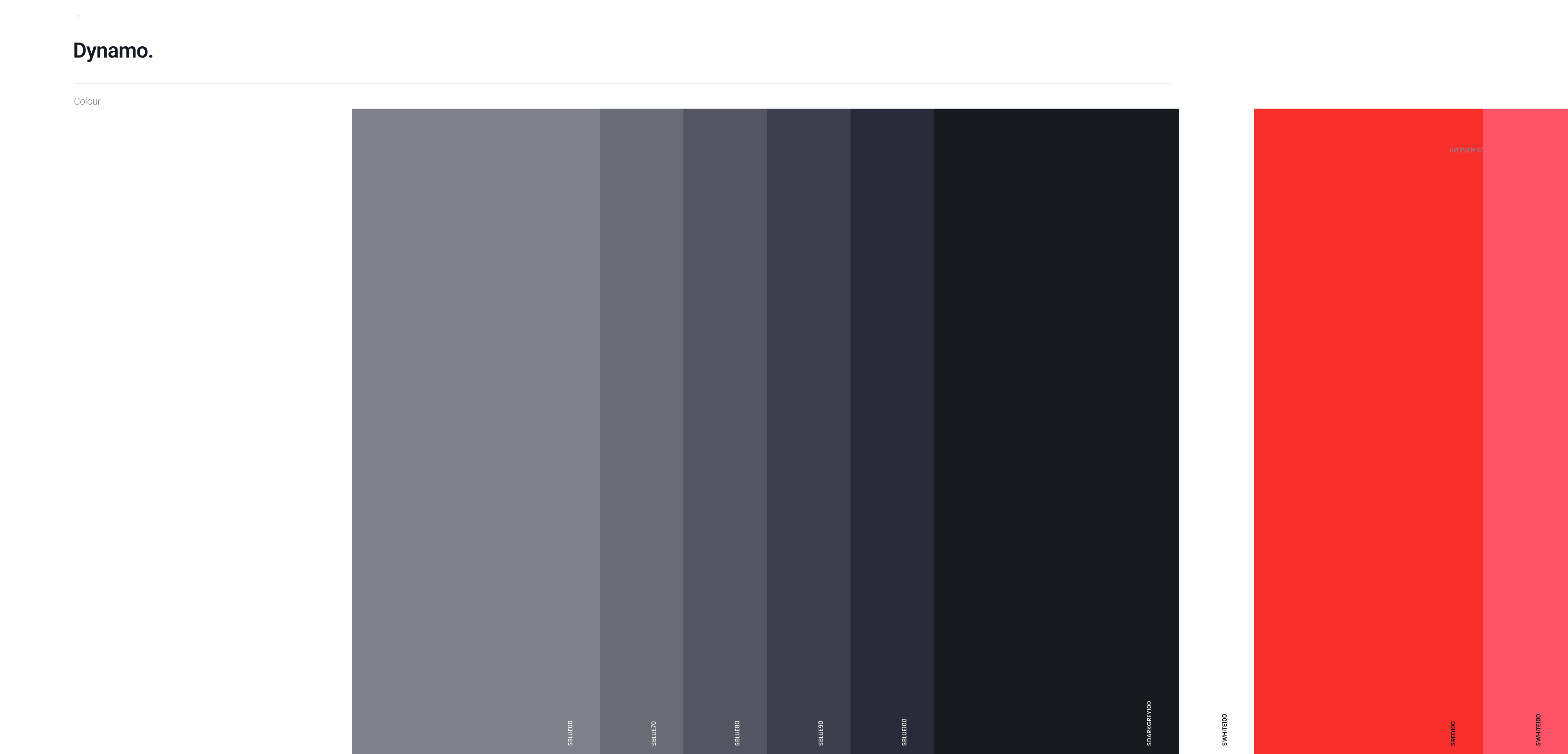
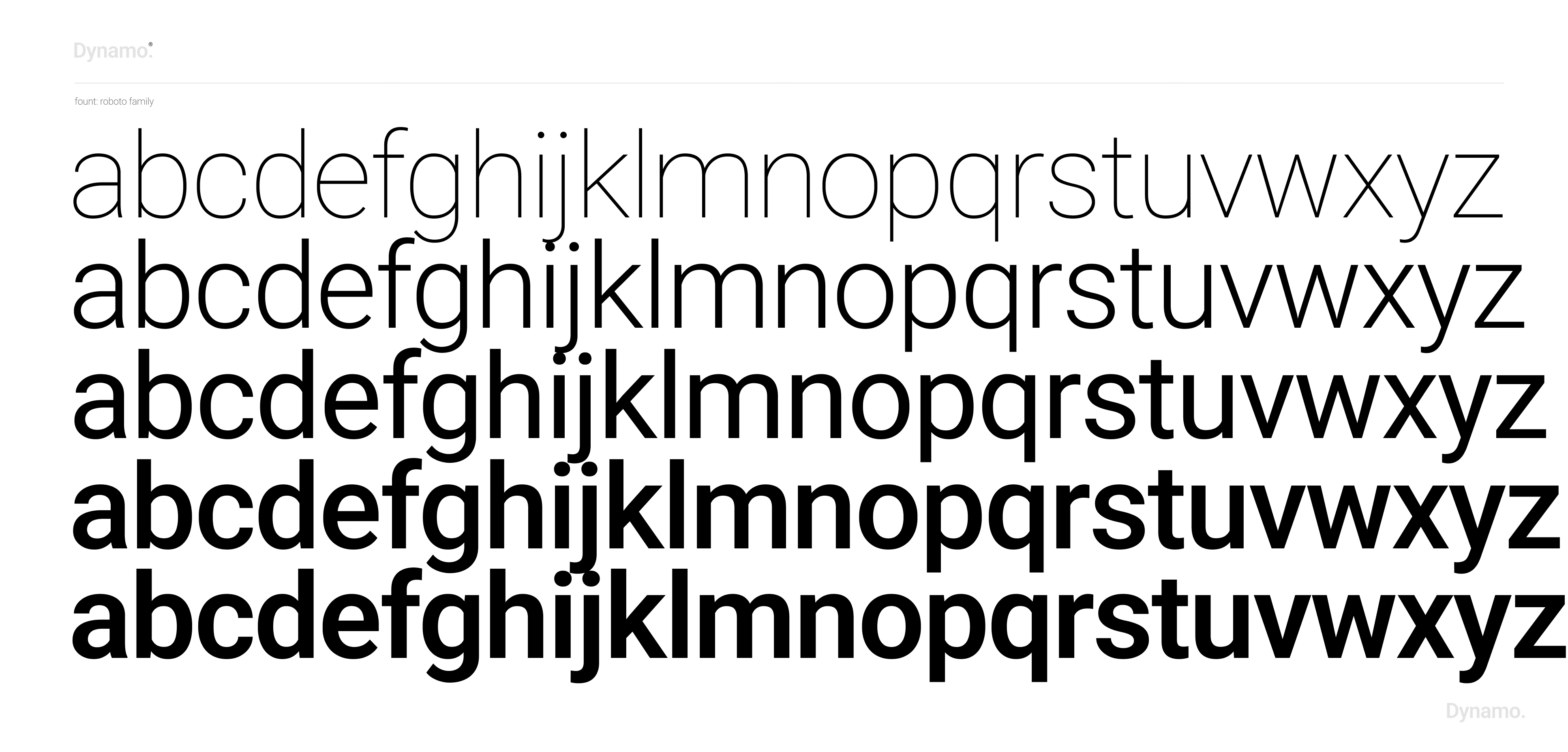
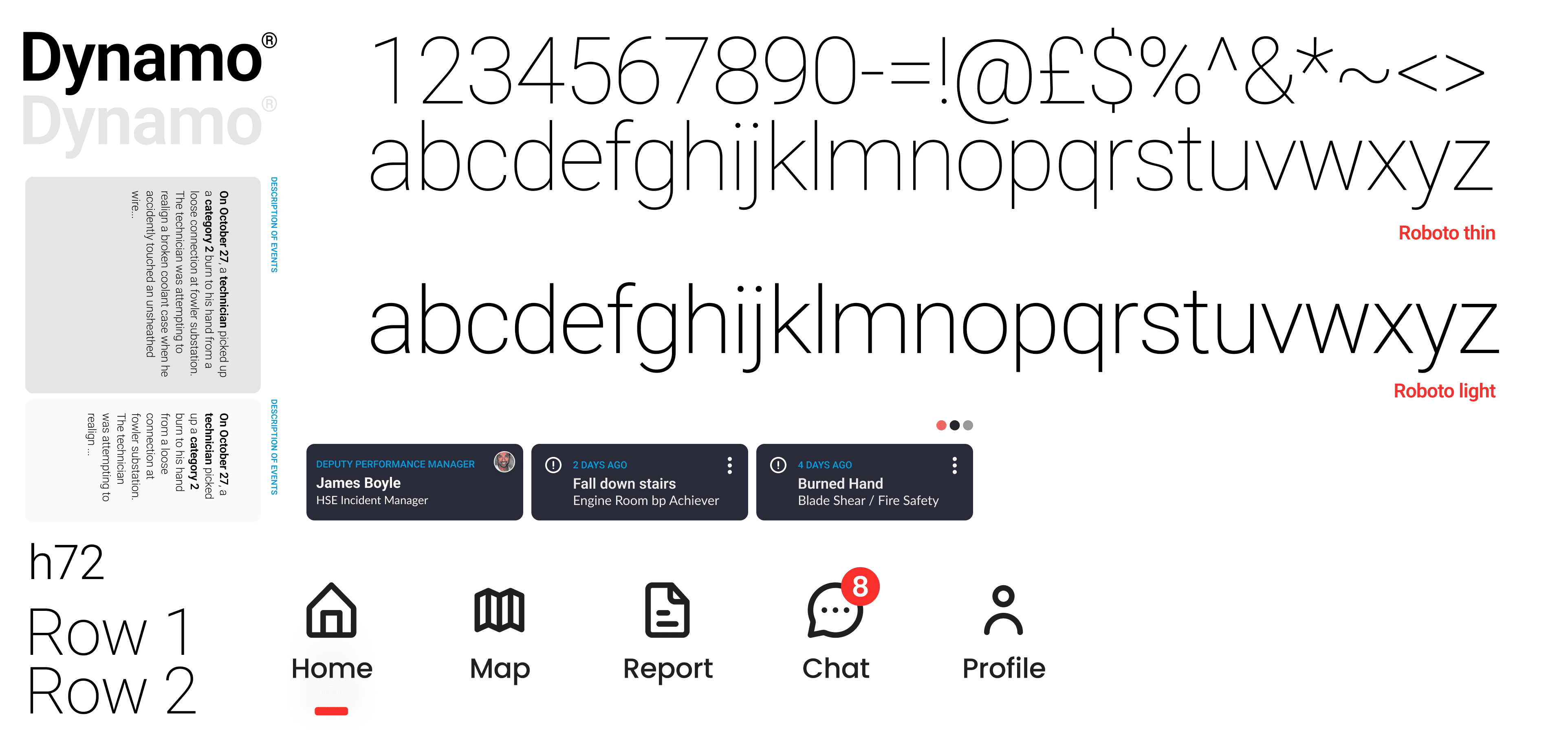
I created a proper brand foundation from the ground up: a logo, colour scheme, type scales, icon set, imagery style, spacing and padding rules, and a clear mission statement.
These were the blocks of a satellite design system, fluid enough to move quickly without being pulled into BP’s main design system (a huge, light-swallowing behemoth), yet smart enough to reuse and align with the parts of BP’s system that already supported my design direction.
To help sell the pitch and secure £8m in funding, I needed to establish a clear brand story that made the product feel credible, cohesive, and easy to understand through visual storytelling.
I created a lightweight, satellite design system that was flexible enough to move quickly outside BP’s overloaded core design system, while staying close enough to brand to avoid unnecessary friction.
In the final 4 weeks, the wider design team was invited into weekly show-and-tells to gather feedback, refine the direction, and align with their own emerging visual standards.
To help sell the pitch and secure £8m in funding, I needed to establish a clear brand story that made the product feel credible, cohesive, and easy to understand through visual storytelling.
I created a lightweight, satellite design system that was flexible enough to move quickly outside BP’s overloaded core design system, while staying close enough to brand to avoid unnecessary friction.
In the final 4 weeks, the wider design team was invited into weekly show-and-tells to gather feedback, refine the direction, and align with their own emerging visual standards.
(2014-26)
Let’s talk.
Tell me about your project-whether it’s a app, website, product creation or a build with Ai.
Quick response.
If you’re ready to create and collaborate, I’d love to hear from you.

Lead Product Designer
Moodflo
Michael Ruocco